Designing for Talent Retention: How Workspace Became a Weapon Against “Japa”
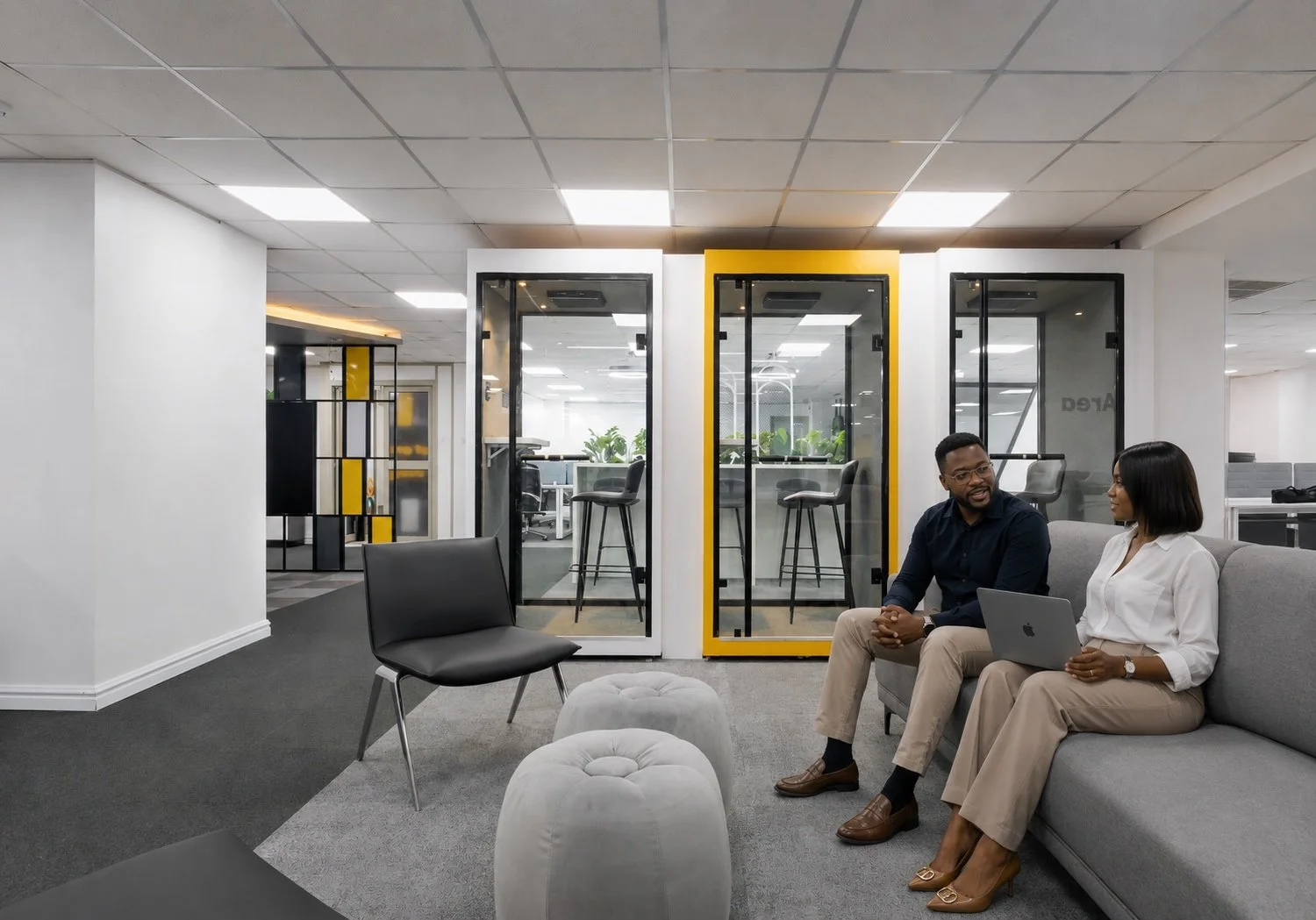
A collaborative lounge space within a Lagos office designed by Micdee.
Skilled talent has never had more options. Quietly, the workspace has become part of how companies hold onto the people they cannot afford to lose.
There is a word that has entered the vocabulary of nearly every Nigerian organisation over the past few years: japa.
The wave of skilled professionals seeking opportunities abroad has reshaped how companies think about talent; not as a resource to be managed, but as one to be actively retained. In technology and financial services especially, the most capable people now have options that simply did not exist a decade ago, both at home and overseas.
In that environment, retention is no longer assumed. It is earned, daily, across every dimension of the employee experience. Compensation matters. Culture matters. Growth matters. But there is a quieter factor that organisations are only beginning to take seriously: the physical environment people walk into every working day, and what it tells them about how their employer sees them.
The talent reality has changed and it is worth being honest about the scale of the shift. The professionals organisations most want to keep; the experienced engineers, analysts, designers and operators are precisely the ones with the most mobility. They are recruited actively. They compare notes. They have a clear sense of what good looks like, often shaped by exposure to global standards. Holding onto them is now a strategic priority, not an administrative one.
And while no organisation can match every offer or remove every reason someone might leave, the ones that retain well tend to get the fundamentals right across the board. The workspace is one of those fundamentals; less obvious than salary, but more visible, every single day, than almost anything else.
Workspace as a signal
Long before an employee has a conversation about culture or values, the space has already spoken. A cramped, neglected, purely functional office communicates something, whether the organisation intends it or not. So does a considered one. The environment is a daily, tangible expression of how much an employer values the people who occupy it.
This is not about luxury. It is about intention. A space that has been thought through; where people can collaborate easily and also find quiet to focus, where the environment reflects who the company actually is, where comfort and wellbeing are designed in rather than left to chance tells employees that their experience matters. That message lands quietly, but it lands every day.
“A cramped, neglected office sends a message about how a company values its people. So does a considered one. The space speaks before anyone in it does.”
The design moves that support retention
When we design with retention in mind, a few principles consistently earn their place.
Collaboration and focus, in balance. The best workspaces let people come together easily and also retreat when deep work demands it. Open-plan energy without quiet refuge breeds fatigue; the reverse breeds isolation. Getting the balance right respects how people actually work.
Wellbeing built in. Natural light, air, greenery, and genuine breakout space are not indulgences. They shape how people feel across a long day, and how they feel is inseparable from whether they choose to stay.
Identity and belonging. A space that reflects the company’s character; its story, its values and its personality gives employees something to belong to. People stay where they feel part of something with a clear identity.
Flexibility. Work patterns have changed for good. Spaces that flex around how people genuinely operate rather than forcing them into a rigid template signal an employer paying attention to the present, not clinging to the past.
What people actually notice
Much of this operates below the level of conscious thought. Few employees will say they stayed because of the light, or left because of the layout. But people respond to their environment constantly; to whether a space feels generous or grudging, designed for them or merely around them. These impressions accumulate. Over months and years, they become part of how someone feels about coming to work at all.
An honest caveat
Design alone will not retain anyone. A beautiful office cannot compensate for poor leadership, unfair pay, or a culture that grinds people down. We would never claim otherwise, and any firm that does is overselling. Space is one lever among several, and it works only in concert with the rest.
But here is what we have seen consistently: where the fundamentals are sound, the right space amplifies them and the wrong space quietly undermines them.
A strong culture housed in a thoughtless environment is fighting itself.
A strong culture given a space worthy of it compounds.
That is the real opportunity.
Designing for your people is not a perk, and it is not merely a cost line. It is part of how you hold onto the talent that is hardest to replace; and in this market, that may be the most valuable thing a space can do. If you are rethinking what your workspace says to the people you most want to keep, we would be glad to start that conversation.